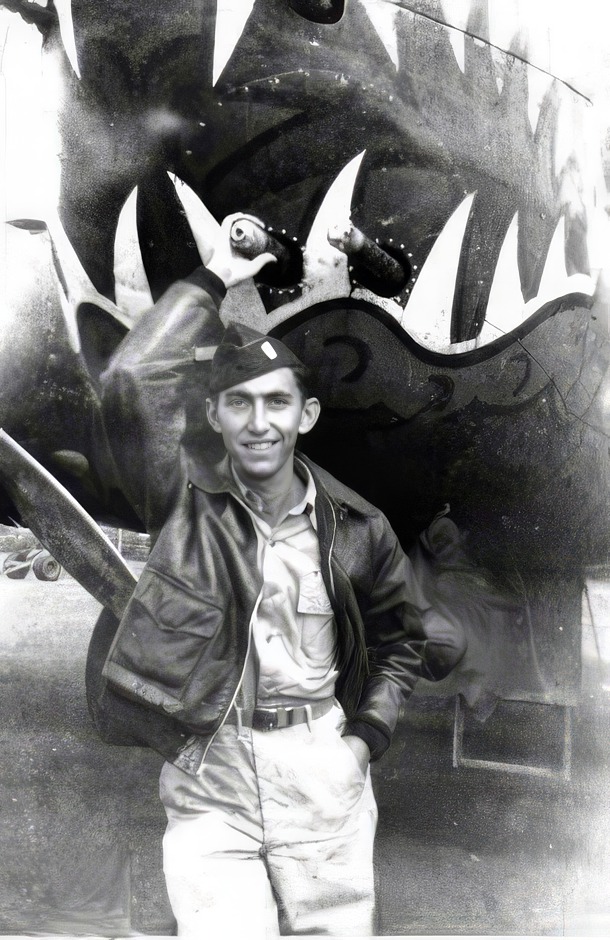
Bernard shows Roman a second photograph — not the October 28th crew photo, but a separate picture of his father alone, standing in front of a B-25's nose art. Roman doesn't recognize the aircraft as one of his own squadron's: "This is probably one of the 498th Squadron, the Falcons," he says, identifying it as a B-25H — a variant that normally carried a 75mm cannon in the nose. On this particular airplane, though, the cannon had been removed, with two machine guns firing out through the same opening instead.
"I see there's like a little something on his cap, like a little rectangle. Do you know what that is?" — "Normally it would be his rank, probably a lieutenant's bar."
Roman can't say much about why Belvin was photographed in front of an aircraft from a different squadron on Biak — likely just there for the picture, in front of what he calls "that unusual airplane." The conversation turns to Belvin's training: Roman explains that Belvin was originally trained as a bombardier, not a navigator, learning the classified Norden bombsight system — down to the self-destruct charge crews carried to keep it out of enemy hands if they went down. As the war went on and the 345th's need for dedicated bombardiers declined, bombardiers like Belvin were retrained as navigators — becoming, as Roman puts it, "a bombardier-navigator," qualified to do either job.
[This is a condensed excerpt for the sketch — the full page would carry the complete cleaned transcript, as already sent to Bernard for review.]
← Back to Roman Ohnemus